

By Dr. Elena Olsen, Inspire Contributor
 Since celebrating our 20th anniversary in 2022, Eastside Preparatory School has been developing more robust connections with the world beyond campus. As Eastside Prep has grown older, wiser, and bigger, it has prioritized retaining the innovative energy of “new school” culture. Stability and tradition are positive benchmarks, but EPS culture has always been defined by its creative and forward thinking community of teachers, administrators, board members, and families. Former Head of School Dr. Terry Macaluso (Head of School from 2003-2023) inculcated this agile, innovative mindset within the fabric of the school. Dr. Macaluso and school founders also did something very simple from the beginning: they prioritized people.
Hiring and retaining strong teachers and nurturing a welcoming community remain at the core of how Eastside Prep operates. One of Macaluso’s longtime goals within this context was to establish a teacher training program. She wanted EPS faculty to be able to teach in new capacities, to help develop future educators by drawing on their own talents and skills as well as EPS values, culture, and mission. Macaluso realized her goal in her final year as Head of School: Eastside Prep welcomed its first two resident teachers in the 2023-2024 school year under the stewardship of Karen Mills (Faculty Development Coordinator and Middle School English faculty) and Matt Delaney (Director of Academic Design and Integration).
“I got to see my mentors self-reflect a lot: about specific lessons, but also about larger pedagogical questions and what it means to be an educator.”
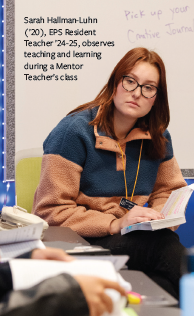
A Dynamic New Learning Community at Eastside Prep The Resident Teacher Program Sarah Hallman-Luhn (’20), EPS Resident Teacher ’24-25, observes teaching and learning during a Mentor Teacher’s class INSPIRE Spring 2026 45
The stated purpose of the Resident Teacher Program (RTP) is to “identify and develop a diverse population of independent school teachers.” In just two years, the impact of this program within and beyond our school campus is tangible. RTP participants have had varied and unique experiences, but they identify relationship-based learning within the context of Eastside Prep school values as powerfully influential in shaping their growth as educators. I was lucky to participate in the program as a Mentor Teacher in its inaugural year and count that experience as one of the most meaningful in my twentyfour years as an educator.
The RTP offers a structured year of training and experience for its participants, moving from a graduate-level seminar, observation, and “spot teaching” in the first trimester to co-teaching and planning in the second term, to independent teaching and facilitating an advisory in the final trimester. Resident Teachers who have participated in the first years of this program were drawn to it for a variety of reasons, but experiential learning is a shared one.
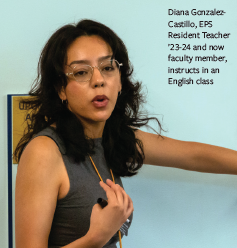
Diana Gonzalez-Castillo (RTP ’23-24 and current EPS faculty) says she was intrigued by the RTP because it presented a “vision of teaching that I was attracted to, [enabling me] to use the education that I had as a liberal arts major and to teach in a way that feels authentic to me.” She recognized that the RTP “would allow me to grow into teaching” by its graduated structure of taking on increasing responsibilities over the course of the year. Sarah Hallman-Luhn (RTP ’24-25) agrees: “It was very customizable to what I needed. I came in with ideas from my Education degree. I was ready to take on a lot from day one, and my mentor and Karen allowed me to do that.”
While Hallman-Luhn entered the program with a BA in Elementary Education with an Endorsement in Special Education and Specialization in Social Emotional Learning, Gonzalez-Castillo entered the program as a recent college graduate with a degree in Women’s Studies—both found the program adaptive to and supportive of their needs. Gonzalez-Castillo’s fellow Resident Teacher, Noah Ching (RTP ’23-24 and current EPS faculty), entered the program after having spent several years pursuing a career in the field of law; he realized through coaching Ultimate Frisbee that his real passion was in education. For him, “embracing the relationship nature of teaching” was one of the most rewarding aspects of what the program offered.
The Resident Teachers emphasize that although they worked closely with their mentors, they felt supported by the EPS faculty as a whole—“a village,” as Gonzalez-Castillo put it. Karen Mills feels that the biggest strength of the RTP is “the learning community that it creates.” This community is “one in which new and mentor teachers work and learn together, take turns leading, engage in shared dialogue about the intricacies of teaching, and build relationships, all of which are main pillars for adult learning.” Gonzalez-Castillo notes, “The faculty was invested in my growth. People were always talking to me about my classroom—the EPS faculty is excited to talk shop.” Hallman-Luhn echoed this observation. “Having faculty who want to share knowledge and experience and open up their classrooms is really important . . . I felt like a sponge.”
Mentors learn and grow alongside their mentees, too. In my experience as a mentor teacher, one of the most valuable aspects of the program was being able to learn with and from Gonzalez-Castillo. Mentors get to see their curriculum and pedagogical approach with fresh eyes; it is an opportunity to revise and renew their practice.
EPS has always taken a village approach to teaching. For Hallman-Luhn, one of the most powerful realizations she had while in the program was understanding how “[Macaluso’s] idea that every student should be supported to become the best version of themselves” is at the heart of EPS pedagogy. “The teachers craft more specific progression and learning targets based on their students’ needs.” In her current position as fifth-grade faculty at Willows Preparatory School, Hallman-Luhn is continuing to focus on her true passions as an educator—differentiated learning and supporting diverse learning styles and needs. An alumni of the Eastside Prep Class of 2020, Hallman-Luhn states, “I looked up to my teachers at EPS so much and wanted to learn how it all worked. I have dyslexia, dysgraphia, and dyscalculia. I wanted to learn about how EPS faculty work so well with students like me, and I wanted to broaden my impact working with students with learning disabilities.”
 For Hallman-Luhn, the RTP provided a valuable counterpoint to some of what she had learned in her undergraduate degree program. Her college experience had provided her with deep understanding of curriculum development and implementation, theory, and systems knowledge; the “hard application of real teaching” she experienced as a Resident Teacher allowed her to combine the more structured approach of her university teaching program and public school student teaching experience with small, independent school adaptability and individualized learning.
Resident Teachers are—whether they know and feel it or not—teachers. From the first time they observe in their mentor’s classroom to Spring Trimester when they sit down to plan a unit, Resident Teachers live the core aspects of an educator’s life: they learn continually through experience, observation, self-reflection, and trial and error, and they bring that learning to their practice by foregrounding student experience. I remember the first conversation I had with Gonzalez-Castillo after she had observed a few of my ninth grade literature courses. She commented that my most talkative class was more prone to complaining, but that the loudest complainers were also the students who embraced structure in the end—who engaged more fully with opening-of-class routines and responded positively to the most structured activities. I remember thinking, “You are already a teacher,” because she was already noticing the complexity of young learners—how social dynamics and classroom culture are as meaningful in the learning experience as course content.
Over the duration of the school year, Resident Teachers bring their observations, reflections, and their own unique styles and approaches to the classroom and EPS is better for it. Karen Mills reflects, “The first time a resident creates a lesson from scratch, presents it in class, and sees the students learn from it is so fun to watch (as a mentor) and so energizing (as a resident). Until you create your own lesson plans and execute them, you do not really know how much preparation goes into the process. Each lesson has to include a learning goal, activities to engage students, appropriate materials, and so many other details. Couple that with classroom management techniques and the students’ variety of needs, and you have a lot to facilitate. There’s a certain rush of excitement when it all goes well, and it convinces you that you actually can do the thing you are learning how to do.”
A hallmark of Eastside Prep learners is their curiosity—students and adults alike share this quality. EPS teachers are passionate lifelong learners. The RTP is a dynamic form of professional development for both experienced and newer faculty. Gonzalez-Castillo comments, “Part of the program is getting to see mentors and other faculty model not only teaching but self-reflection. I got to see my mentors self-reflect a lot: about specific lessons, but also about larger pedagogical questions and what it means to be an educator.” Mills remembers the intensity of this self-reflection in her role as a mentor during the 2024-25 school year. “I had to be able to answer my resident’s ever-present question, ‘Why?’ Why do you teach one skill before another? Why did you start class like that? Why did you grade an assignment this way? The constant reflection of my own practice strengthened the beliefs and methods I bring to my classroom, and made me feel even more impactful as an educator.”
For all their skill, teachers can also be their own harshest critics. Continual critique and interrogation of one’s own practice is an irony of being a good teacher. Teachers keep smiling and project calm even as they’re wondering how that lesson they just taught could have been more engaging, or worrying about any number of small details and big questions. For those of us who’ve done it, teaching is one of the most rewarding and FUN careers possible. It can also be fatiguing. So, when schools support the expertise of their own faculty and find ways for faculty to share and hone that expertise, students and teachers learn better and are happier. As Ching observes, “We thrive as a community when both students and educators ask good questions, reflect, and are willing to adapt.” We see this zeal for inquiry and the art and science of education radiate even more brightly throughout the community because of the Resident Teacher Program. It will be exciting to see how its participants and the community as a whole shape its evolution over the next twenty years.