

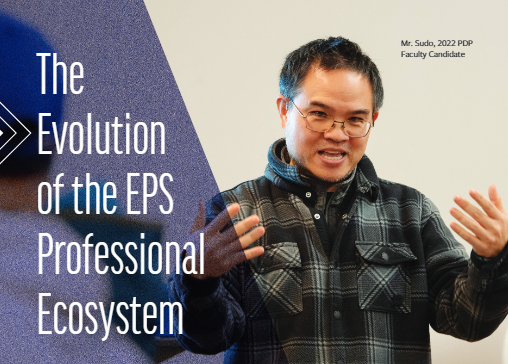
By Matt Delaney, Director of Academic Design & Integration
In June, after students wrap up final assessments, performances, and projects, a different kind of culminating experience unfolds for the Eastside Prep faculty and staff as they share their work in an end-of-year forum. The Professional Development Project (PDP), now in its sixth year, is one of the core learning processes available to adults in the EPS community. It allows both faculty and staff to do something increasingly rare in schools: engage meaningfully in reflection, collaboration, and synthesis alongside colleagues.
EPS developed the PDP to address a familiar challenge in the teaching profession: unlike many careers, there is no formal ladder for growth without leaving the classroom. EPS launched the PDP in 2018–19 to recognize professional growth at particular points in a teacher’s professional trajectory.
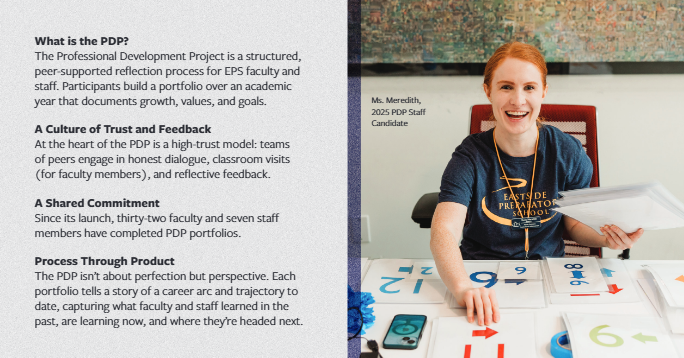
This year, for the first time, the final PDP forum featured a combined panel of both faculty and staff. Ten participants—seven faculty members and three staff members—shared insights from professional portfolios that they constructed over the past nine months.
PORTFOLIO AS PROCESS, NOT PRODUCT
The PDP offers a structure and the support of a team of peers to help faculty and staff document their growth, reflect on their practice, and surface their values. Each participant works in a five-person team with a colleague facilitator who has completed a portfolio in a prior year. Teams meet six to eight times over the course of the academic year; each meeting linked to a distinct category of professional practice and performance.
Both the faculty and staff frameworks are informed by three shared values: 1) reflection and growth, 2) collaboration and feedback, and 3) professional responsiveness. For faculty working toward advancement, the PDP includes four domains—Professional Practice, Pedagogical Practice, Curricular Design, and Relational Cultivation—each with subcategories that help define high-quality teaching and broader professional performance.
CROSS-FUNCTIONAL GROWTH AND THE ROLE OF FACILITATORS
As the program has evolved, so has the representation of the variety of roles in which faculty and staff function. Staff portfolios document professional themes and practice. Faculty portfolios document shifts in areas like pedagogy and assessment philosophy. Regardless of focus, each portfolio is supported by a central relationship: candidate and facilitator. This relationship—collegial, trusting, iterative—is at the heart of the PDP.
Facilitators are not evaluators. Their role is to provide feedback and support, asking generative questions, modeling the same reflective habits they employed in their PDP portfolio process, and championing the effort of their colleague. While the team structure fosters community, the candidate-facilitator pairing is where the deepest and most meaningful development happens.
The PDP is made possible by the high-trust culture of the EPS community. The model works because participants are willing to be vulnerable, offer critique, and engage in reflective exchange with peers, many of whom work in different parts of the school and school program. Team composition is intentionally varied and diverse, drawing members from different academic disciplines, offices, and career stages. This diversity strengthens dialogue, encourages multiple perspectives, and reinforces a culture of inclusion within the professional community.
REFLECTION AS A FORM OF ALIGNMENT
The PDP has become one of the most powerful tools for alignment in the EPS professional ecosystem. The model and process do not ask faculty and staff to become more alike in function. It asks them to become more attuned to their own direction, and to articulate that direction in a way that others can engage. The result is a professional culture where individual clarity contributes to collective understanding, where the whole is greater than the sum of its parts.
At the close of the 2024–25 academic year, thirty-two faculty members and seven staff members have completed a PDP portfolio. Each year, the staff and faculty frameworks are revised based on feedback, and the new portfolios added to the shared library to help future participants understand the breadth of possibilities. The revision process is iterative by design, reflecting the same ethos that EPS cultivates in its students: that meaningful growth requires clarity, curiosity, and courage.
LIVING THE VALUES WE TEACH
Students at EPS are regularly asked to reflect, iterate, and share their learning with others. The PDP ensures that adults are doing the same. It models a professional version of the same habits and mindsets that the school aims to instill in its graduates. And by bringing faculty and staff into one shared process, it reaffirms a core principle of the EPS mission: that learning is not done in isolation or constrained by role; it happens in connected relationships in the context of a community designed and enacted through shared language, structures, and purpose.
The PDP will continue to evolve. It represents something rare in the landscape of adult professional development: a flexible structure with room for exploration that is light on compliance and heavy on meaning; space for depth, a model for growth. Most importantly, it sends a clear signal that the school invests in the adults who are at the center of the development of students. The PDP has persisted and grown through remote instruction and a return-to-campus transition, proving to be adaptable, durable, and continually evolving.