

By Verity Sayles, Associate Head of Upper School
There is nothing like getting a license. I STILL remember driving my 1997 Subaru Outback to school for the first time. It was teal green and always smelled like Dunkin’ Donuts. (The true marker that you were driving yourself was rolling into first period with a coffee from Dunkin’. No more bus or parent drop-off; freedom meant a large, iced coffee.)
What I didn’t think about as I drove through the snowy Massachusetts streets or cracked the windows on the warm spring days to peel out of the high school parking lot to my part-time job, was that a lot of scaffolding made that freedom possible. The hours of driver’s ed, the permit, the time driving with my parents, the curfews, the expectation that I would drive my younger sister, my parents help when the oil needed to be changed, that if I was gone too long, an adult would notice.
Freedom felt absolute. Until, of course, I got my first speeding ticket, and in addition to having to pay $150, my parents didn’t let me drive for a week. There are limits to everything.
Over fifteen years as a high school educator, I’ve watched hundreds of students earn the privilege of their license. I’ve watched them learn how to get to school on time, how to leave enough margin to park and walk in without panic, how to manage the responsibility of being in charge of their own arrival. I’ve also watched them make mistakes along the way: parking in the wrong spots, fender-benders on the morning commute, yes, even receiving their first speeding tickets. Juniors and seniors navigate the freedom of driving to and from school, real autonomy paired with real consequences.
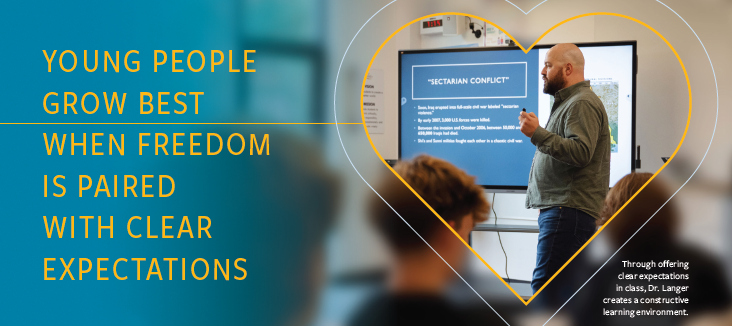
At the same time, freshmen and sophomores are learning something quieter but no less important: clearing lunch tables in the LPC, returning chairs, and caring for shared spaces before moving on with their day. These moments may look worlds apart, but they are guided by the same philosophy: that young people grow best when freedom is paired with clear expectations, and when responsibility is taught not through control, but through trust, structure, and care. We set standards and we expect our students to rise to them.
It’s hard for young people to see this sometimes. Yes, we have to set rules. Yes, those rules will be pushed and tested. However, I believe navigating rules with privileges is grounded in a deep respect for who teenagers are becoming. It is not about the rules we set, but how we set them and how they are communicated that matter just as much. Clarity around rules is kindness for our students.
This summer, I read 10 to 25: The Science of Motivating Young People (highly recommend). Author and psychologist David Yeager is a professor at the University of Texas at Austin and writes of challenges that he calls the “neurobiological incompetence model” of adolescence—the idea that young people are fundamentally irrational, impulsive, and incapable of meeting high standards. In a conversation with FutureEd he says, “If you have bought into the idea that teenagers lack a prefrontal cortex, that they’re impulsive and short-sighted, that they don’t think about what they should be doing in the future, then you won’t support young people in meeting high standards because you believe they are unlikely to meet those standards.” In his research, Yeager found that the most successful schools and organizations were those that treated young people not as problems to manage, but as “amazing resources who do great work.”
Yeager describes an approach that he calls the mentor mindset, which deeply resonated with how I see the adults at Eastside Prep as we work with young people. According to his research, setting boundaries as a mentor is far more effective than acting as either a “boss” or a “buddy.” Bosses demand compliance without a relationship. Buddies offer warmth but lower expectations. Neither approach helps adolescents thrive. The mentor mindset, instead, combines high standards with high support—a balance that reduces behavioral problems, increases motivation, and strengthens engagement. This type of thinking shapes how we think about discipline, restoration, and responsibility at EPS. We aim to be clear, consistent, and firm about expectations while remaining connected, respectful, and invested in students’ growth. Clarity, in this framework, is not harshness; it is a kind of guardrail for our students.
A driver’s license is not proof that someone has mastered judgment; it is an invitation to practice independence within guardrails. Speed limits, seatbelts, and graduated privileges do not limit freedom; they make learning possible while mitigating harm. When EPS grants seniors the ability to drive off campus throughout the school day, we pair that freedom with clear expectations because we believe students are capable of rising to them. Sign out with a QR code. Don’t miss class. Buckle up.
The same principle applies in lower-stakes spaces, like the lunchroom. In the LPC, students are expected to clear their tables and care for the shared environment. Advisory groups support lunchroom cleanup because responsibility is learned through repetition and modeling. Research suggests that young people are highly motivated by a desire for status and respect—to be seen by peers and adults as competent, mature, and trustworthy. Clearing a table, returning a chair, or following campus norms is not just about rules; it is about reputation: I am someone who contributes.
And sure, boundary-pushing is part of this developmental process. Teenagers test limits in the way new drivers test speed. It’s not always out of defiance, but out of calibration. That’s why it is important that expectations are not vague or inconsistently enforced. That is not freedom, it’s uncertainty, and uncertainty invites risk. Clear, predictable boundaries reduce anxiety, power struggles, and the need for students to “test” the system to understand it.
And when the boundaries are tested too much? When a rule is violated? Then our restorative practice shifts the focus from punishment to meaning. Young people are more likely to accept feedback when it is paired with a message of belief. Missing standards are framed not as disappointment, but as confidence in their potential. In restorative conversations, we ask questions such as: What decision was made in the moment?
Who was affected or harmed? What needs to happen to repair trust and restore safety? Accountability, in this framework, is not about shame. It is about responsibility, learning, and repair. Restorative practices are not an easier path. They require time, emotional honesty, and adult steadiness—especially in serious disciplinary moments. They also require clarity. Adolescents learn best when expectations are predictable and when adults remain present even after mistakes are made.
Whether a student is learning to manage the freedom of driving or the daily habit of clearing a lunch table, the lesson is the same: freedom and care are inseparable. Kindness through clarity means trusting students with real responsibility, being explicit about expectations, and staying engaged when things go wrong. Teenagers may not always thank us in the moment, but over time, clarity builds trust. Trust builds safety. Safety allows young people to grow into the people who are inspired to make a better world.