

By Katie Meredith, Administrative Assistant to Institutional Advancement
WHAT HAPPENS WHEN students follow their passions?
At EPS, the answer is extraordinary. From the stages of New York to conversations with renowned medical professionals, from publishing groundbreaking research to engineering solutions for global challenges, our students are turning their interests into real-world impact. Through their unique pursuits, these students remind us that the best learning often happens when we dare to dive deep into what we love.
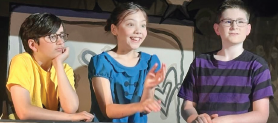 Coco (’31) and Daniel (’30)
What is the best part of summer break? Some students would say sleeping in, staying up late, or swimming, but for Coco and Daniel, summer means free time to immerse themselves in their passions. This past summer, they spent three action-packed weeks at Stagedoor Manor, a renowned acting institute in upstate New York. Since 1976, Stagedoor Manor has been helping aspiring actors find their voices onstage, many of whom have gone on to professional acting careers. The students lived together in dorms and shared rooms with students from all over the country. Limited access to tech (once a week for a phone call home) encouraged the students to be present with one another and work together throughout the experience. Reflecting on his summer, Daniel said, “At camp, my singing got a lot better. I learned how to sing with an ensemble and blend. It’s different than singing a solo by yourself.” Coco added, “The teachers there are really good at what they do. I learned a lot from them.” At the end of the three weeks, Daniel and Coco performed in the Stagedoor Manor production of You’re A Good Man, Charlie Brown. “The camp is a big commitment but for me it was worth it. Actors need to make connections and this was a good way to do that,” Daniel said. Coco confirmed, “I can’t wait to go back—I’m already signed up to go back next year.”
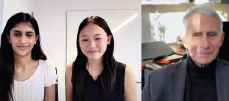 Manaswini (’27) and Felicia (’28), EPS Medicine Club
The EPS Medicine Club recently interviewed Dr. Anthony Fauci and learned how he discovered his passion for medicine. The conversation was facilitated by club leaders Manaswini and Felicia. Dr. Fauci currently serves as the Distinguished University Professor in the School of Medicine with the McCourt School of Public Policy at Georgetown University. Prior to this current role, he spent fifty-four years working at the National Institute of Allergy and Infectious Diseases at the National Institute of Health. Over the course of his career, Dr. Fauci has advised seven U.S. presidents and helped develop the COVID-19 vaccine.
Growing up, Dr. Fauci spent his early years delivering medicine from his father’s pharmacy on his bicycle route. From an early age, he had a deep desire to serve others. In college, he wanted to combine serving others with his interest in science, leading him to pursue a career in medicine. He shared, “The most important thing I’ve learned is how to respond to complex situations using my skills and collaborating to solve problems.” When asked about choosing a career, he suggested, “Find what you feel passionate about…but know that career paths are often nonlinear. Realize that you need to keep an open mind to opportunities that fall in front of you and be flexible enough to pursue them.”
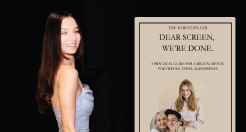 Nikita (’28)
It’s no secret that teens don’t have it easy. Every day, teens navigate identity formation, peer pressure, and increased agency to make their own choices as they experience this critical stage of life. With the rise of social media, being a teen today is arguably harder than it has ever been before. Social media can help teens connect, but it can also cause increased feelings of isolation and loneliness.
In response to these complex challenges, Nikita engaged in her own reading and research. She said, “Teen mental health and social media is a huge issue among teens, but we don’t really talk about it much. I found a lot of sources on this topic, written by adults, that seem to talk at you, not with you.” Inspired to bridge this gap, Nikita started writing her own book in ninth grade. She read numerous articles and case studies to inform her writing. Her book Dear Screen, We’re Done: A Practical Guide for a Digital Detox for Tweens, Teens, and Parents was published in September 2025. By combining research with personal experiences, her book provides teens with tools for regaining agency and creating a healthy relationship with social media.
Nikita believes that teens’ futures are being shaped by the choices they make today. Rather than feeling controlled by the addictive nature of social media, she hopes to give power back to teens. Her suggestion to teens navigating these rough waters is to get support from friends, in addition to accountability from their schools, parents, and communities. Nikita said, “I want to help students find their passions and meaning in life outside of social media. I want teens to understand how social media can both connect and consume, because the world inside the screen is infinite, but the world outside is alive.”
 Aria (’26)
 When she was a child, Aria learned that her great-great-grandfather’s farmland in Venezuela had been unjustly seized by the government. This injustice sparked her interest in a broader crisis: in many rural areas, unreliable energy for irrigation was leaving once-fertile fields barren and creating widespread food insecurity. Women farmers faced additional barriers, often receiving lower wages than their male counterparts for the same labor.
“Historically, women farmers have been economically trapped by systemic barriers,” Aria said. “Women produce the most crops, yet they own the least land. Women farmers in these countries have the least money, training, and access to power.”
In Upper School, Aria’s growing interest in energy and climate resilience inspired her EPS independent project, Blackouts to Breakthroughs: Powering the AI Era and Decarbonizing the Grid. She analyzed our carbon-dependent electric grid and researched sustainable alternatives. Upon completing her project, she returned to issues of food insecurity and energy access for women farmers and sketched her first prototype of a solution.
After learning to weld metal, Aria built her prototype from low-cost materials such as recycled bike wheels, batteries, and solar panels. The result is called Heliogrid—a lightweight, collapsible, portable energy system fully powered by solar panels. “I created a mobile energy system with the intention of supporting women. A static system would be tied to physical land, but a mobile system can be moved and used anywhere,” Aria said.
When sanctions prevented shipping materials to Venezuela, Aria pivoted. With guidance from Professor Shon Hiatt at USC, she expanded her vision and is now working on pilot programs in India, Ecuador, and Tanzania to power irrigation pumps, school kitchens, and even small businesses. “I’m currently working with Dharma Life, a nonprofit in India focused on women using Heliogrid for power, and another organization in Tanzania using the system to power induction cooktops at schools so students can have hot meals,” she said.
“My dream is to empower many people, especially women, through this work. As I connect with partners around the world, I hope this project will have a lasting impact on future generations.”