

By Karen Mills, Literary Thinking and Faculty Development Coordinator
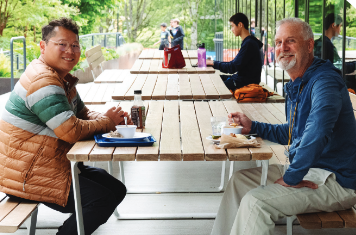
Above: 2023-2024 Resident teacher Mr. Ching enjoys
lunch with fellow Science faculty and coach Mr. Waltzer.
How can I best serve my students? I ask myself every day of every school year. The answer is often simple and requires me to take small actions, like extending a due date or explaining an idea in a different way. On the other hand, sometimes the answer is complex and requires greater creativity, focus, and time. Such was the case as I mentored Resident Teacher (and EPS alum, Class of 2020) Sarah Hallman-Luhn during the 2024–2025 school year.
Since its implementation in September 2024, the Resident Teacher Program (RTP) has had two clear goals: 1) prepare new teachers for the independent school classroom and 2) strengthen the skills of current faculty members. If the goal of the program was to prepare a new teacher for the independent school classroom, I knew, to best serve Hallman-Luhn (my “student” in this situation), that I would need to be intentional in my approach as her mentor.
Pulling back the curtain seemed like one way to start. Imagine seeing all the “hidden” parts of a teacher’s day, the “backstage” minutiae of planning classes and units, crafting classroom culture, differentiating instruction, assessing student learning, partnering with colleagues, and so on. Most people haven’t considered most of the details that have to be prepped and synthesized before a single class can take place. I got to show Hallman-Luhn all of it over the course of the year as we met regularly, shared materials, and prepped classes together.
Modeling was another important part of my approach. After learning the backstage mechanisms, I knew that Hallman-Luhn needed to see all the parts come
together in the classroom, needed to see what the final “performance” looked like. She observed me teaching classes for several weeks. She listened to me explain concepts and interact with our students. She watched me adjust agendas on the fly, move around the room for proximity management, and celebrate small moments of fun or success. She noticed tough moments, too, when things didn’t go as planned. I was constantly modeling, constantly “on stage” for much of the year so that Hallman-Luhn could see teaching in action.
The next major focus, as Hallman-Luhn began to teach, prep, and assess on her own, was coaching. The tables turned and I got to see her in front of the class, listening to how she delivered content and spoke to the students, watching how she adjusted agendas, moved around the room, and celebrated with students.
I took notes on what I observed and shared them with her after each class. I made suggestions for improvements, complimented strong moments, and workshopped ideas with her for future agendas. For me, coaching was about meeting Hallman-Luhn where she was and helping her cultivate skills and ideas to keep progressing.
One part of my approach to mentorship developed as our partnership strengthened, and incidentally became critical for my own professional growth, too. Early in the year, I learned that I needed to be vulnerable for us to have a successful year together. Sharing the minutiae of my professional practice was an exercise in laying out all my ideas for someone else to see. And question. And perhaps judge. The same goes for modeling. I had to learn to be comfortable with that kind of exposure, when what I would have preferred was for everyone to see no flaws or imperfections. I worked through that discomfort as Hallman-Luhn worked through hers, and I think we both felt stronger for it.
I’ll mention one last piece of my approach to mentoring—celebration. Positive moments—both little and large—deserve to be recognized and applauded. A reserved student volunteered an answer without prompting? Celebrate! A resident teacher successfully completed the RTP and got a job teaching in an independent school? Celebrate! As a mentor, I gave props as often as I offered suggestions so that Hallman-Luhn could feel good about her strengths and use them to work through her challenges.
When I ask myself, “Did I best serve my student?”, I like to think the answer is yes. I believe my approach to mentoring, coupled with the structure of the RTP, provided Hallman-Luhn with the support she needed to flourish. And as the RTP grows and evolves, I’m equally excited by how it continues to challenge and inspire me, too.
RTP UPDATES FOR 2025-26
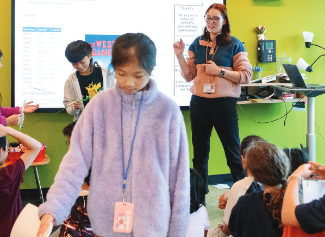
024-2025 Resident teacher Ms. Hallman-Luhn
facilitates a Literary Thinking lesson.
As with any course of learning, time to reflect on the successes and areas of improvement is essential to keeping the course relevant and impactful.
The structure of a school year—with a clear beginning and end—gives educators space to reflect, make adjustments, and plan for the new course. So, at the end of the second year of the RTP in June 2025, Matt Delaney (Director of Academic Design and Integration), Krista Henningsen (science faculty and Academic Design Coordinator), and I reflected by asking ourselves questions we might ask our students in the classroom: What worked this year? Did we reach our targets? What didn’t hit the mark? What did we learn, and how can we apply that learning in the future? We also considered reflections received from the 24–25 residents and mentors, and then focused our “course revisions” for 25–26 on areas we felt would serve the new cohort in the best way possible.
So begins our third year of the RTP. The format of the program remains much the same but there are new elements intended to enhance the experience for participants. For instance, starting this year, each resident will complete a teaching portfolio to track their progress and showcase what they’ve learned. This should help highlight their areas of strength and growth, as well as serve as a resource in the job application process. Another addition to the program is a “faculty panel” that accompanies fall seminars; each panel consists of current faculty members sharing their expertise on a teaching topic associated with the week’s seminar. Past residents have enjoyed learning from faculty across the disciplines, including those who are not formally part of the RTP, and we anticipate that this will open up even more opportunity for learning, sharing ideas, and building relationships.
These changes begin with our third cohort of the RTP. We are pleased to have Alex Liu join our Eastside Prep community. Liu is a recent graduate of Washington State University with a degree in kinesiology and experience in coaching and mentoring youth athletes. Melissa Hayes, long-time physical education teacher and athletics coach, will mentor Liu.