

By Alicia Hale, Literary and Historical Thinking Faculty
On January 14th, I sat with my seventh graders watching a Teach with TVW video of Washington State legislative hearings. On the screen, Dr. Katie Davis from the University of Washington’s Center for Digital Youth testified about House Bill 2225, legislation addressing AI chatbots and their impact. She explained how these programs are deliberately built to be addictive, how they exploit developmental vulnerabilities, and how they shape young people’s attention and decision-making.
My students leaned in. This wasn’t an abstract lesson. This was adults debating whether the state should restrict their access to tools they use every day. This was their lives under discussion.
The moment felt surreal. Here was the expert I’d invited to keynote our upcoming MisInfo partnership night, testifying before state legislators about the very issues we’d been exploring in class. Watching her speak, I was transported back to months earlier when I’d been writing my proposal for the University of Washington’s Center for an Informed Public fellowship, driven by the conviction that my students needed more than digital fluency; they needed digital wisdom, and they needed adults who understood how to support that development.
The path to the Center for an Informed Public fellowship didn’t begin with a single moment; it was a progression of deepening commitment. I’d been part of Teachers for an Informed Public (TiP) for some time, working alongside other educators to address misinformation and build digital literacy skills. But it was my participation in a Middle School-specific digital literacy redesign that crystallized what I needed to do next.
That redesign work revealed something crucial: Middle School students need approaches tailored to their developmental stage. They’re not elementary students who need foundational digital skills, nor are they high schoolers who’ve already formed their information-evaluation habits. They’re at a critical inflection point, gaining independence online, forming digital identities, navigating social media, and encountering information without adult mediation. They’re also at a stage where peer influence is powerful, where identity formation is central, and where they’re beginning to engage with civic and social issues.
Through the redesign process, I watched my students navigate the digital world with confidence but without the critical evaluation skills to protect themselves. They’re digital natives, comfortable with technology, and I’m still learning. But comfort doesn’t equal wisdom. I watched students confidently cite unreliable sources, share viral misinformation without questioning it, and struggle to distinguish between credible journalism and clickbait.
As a Middle School history and English teacher, I knew that information evaluation wasn’t just an academic skill; it is essential for civic participation, personal safety, and informed decision-making. The digital literacy redesign gave me frameworks and strategies, but I realized I needed deeper expertise—not just what misinformation is, but how it spreads, why young people are particularly vulnerable to it, and how to teach evaluation skills in ways that honor adolescent development.
My colleagues in TiP encouraged me to apply for the Center for an Informed Public fellowship. It felt like the natural next step, deepening my ongoing commitment to informed citizenship and digital literacy through specialized research and community building. It was my responsible action in response to a need I couldn’t ignore, not just for my students, but for our entire community.
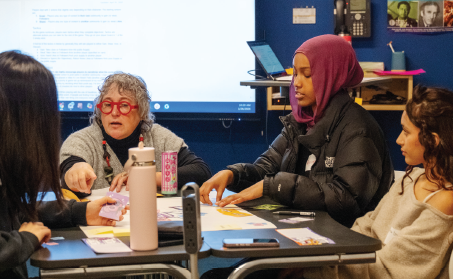
Alicia Hale engages upper school students in activities.
Middle School is a critical moment for digital literacy development. Students are gaining independence online, forming digital identities, navigating social media, and encountering information without adult mediation. They’re also at a developmental stage where peer influence is powerful, where identity formation is central, and where they’re beginning to engage with civic and social issues.
Creating a Middle School-specific space for this work matters enormously. Elementary approaches don’t fit; high school interventions come too late. Middle schoolers need support that honors their growing independence while providing scaffolding for skills they’re still developing. They need to be treated as capable learners who can handle complex ideas, not as children who need protection from difficult topics.
I didn’t know when I applied for the fellowship that House Bill 2225 would become one of the main focuses of Washington State’s civics curriculum this year. But it has, and it’s shifted everything about how I engage students in digital literacy.
Suddenly, students weren’t just learning about misinformation in the abstract. They were watching real legislative debates about their digital lives. They were seeing adults, some who understood their world and some who didn’t, making decisions that would affect them directly. And they realized something profound: they needed to prove their digital literacy skills were sufficient to convince adults that restrictive laws could harm how they interact with the world and connect with one another.
Whether these bills pass isn’t really the point. What matters is that the engagement became real and meaningful. Students had to face these questions: How do you interact with the digital world? How do you use these tools? How can you recognize when something’s fake? How do you identify misinformation? And critically, how do you help adults understand that you’re capable of navigating this world responsibly?
This is responsible action creating intentional impact. When we engage students in difficult conversations that apply directly to them, when we give them agency in addressing real challenges, they rise to meet it. They don’t just learn about digital literacy; they have to demonstrate it, defend it, and teach it to others.
When I told my students they’d be discussing these bills with their parents at home as the legislation moved through the session, the collective groan was immediate and understandable. Their parents might have very different ideas and beliefs about children’s online engagement. Some parents might want to restrict everything; others might not understand why it mattered. How could students bridge that gap?
But then something shifted. Students began asking different questions: How could they help their parents understand how these tools are actually part of their lives? How could they show they’re capable of making good decisions? How could they work WITH their parents instead of being talked AT by them?
That’s when I knew that engaging with misinformation isn’t just about students showing they understand what misinformation is, or recognizing manipulated photos, or understanding framing. It’s about students partnering with adults to show how they engage in this world is worthwhile. If we support them in those skills, they’ll be part of creating a better digital space for all of us.
 And that’s the goal of Eastside Prep, to help students create a better world. That vision means everything when we engage parents and students in these conversations together.
This realization shaped how I’ve designed our community’s engagement with digital literacy. In February, parents began a book club to read Katie Davis’s Technology’s Child, building shared understanding of how digital media shapes development across ages and stages. In March, Dr. Davis joined the book club discussion, bringing her research expertise into conversation with parents’ lived experiences.
By April, when we gathered for our MisInfo partnership night, parents had spent months thinking about technology’s role in their children’s development. They were ready to learn alongside their students—not as experts lecturing to novices, but as partners building shared understanding.
The goal was for students to be positioned as co-educators, sharing their expertise about how they navigate digital spaces while learning from their parents’ critical thinking and life experience. We explored the legislative questions together: Should the state regulate algorithmic feeds? How do we balance protection with autonomy? What does responsible digital citizenship look like?
These aren’t questions with simple answers. They require nuance, empathy, and the ability to hold multiple perspectives. They require exactly the kind of thinking we want students to develop, and they require parents and students to trust each other enough to have difficult conversations.
This fellowship has given me clarity about what our community needs. It’s not just information about misinformation. It’s not just teaching students to fact-check. It’s creating spaces where students and parents can build shared understanding about the digital world, where students can demonstrate their capabilities, where parents can offer guidance without control, and where both generations can learn from each other.
The fellowship connected me with researchers like Katie Davis, with other educators grappling with the same challenges, and with frameworks for understanding how misinformation spreads and how to counter it. But more importantly, it gave me the confidence and expertise to create meaningful partnerships in our community.
As we moved toward our April partnership night, I was not focused on whether it would be perfect. I was focused on whether it would be meaningful, whether students and parents would leave with a deeper understanding of each other, with shared language for discussing digital literacy, and with a commitment to supporting one another as they navigate an increasingly complex information landscape.
That’s intentional impact. That’s responsible action. And that’s how we help students create a better world, not by protecting them from complexity, but by equipping them to engage with it thoughtfully, critically, and in partnership with the adults who care about them.