

By Amy Pannoni, Board of Trustees President
One of the greatest privileges of being a member of an independent school Board of Trustees is the opportunity to collaborate with school leadership. That critical work in shaping a school’s direction—when done well—is behind-the-scenes engagement that most families never see. When these trustee-leadership relationships operate in clear lanes, in alignment with the Eastside Prep mission and grounded in trust, they are the quiet engine that drives institutional stability and long-term strength. At its core, these working relationships are a study in shared leadership, built on mutual respect, clarity of purpose, and a shared commitment to the school’s success. A strong partnership will impact how effectively a school navigates challenges, embraces opportunities, and sustains its values across the decades.
TWO ROLES, ONE MISSION
Leadership opportunities on the Board take many forms, ranging from the Executive Committee (President, Vice-President, Secretary, and Treasurer), to Committee Chairs (Institutional Advancement, Assets Management, Committee on Trustees, Health and Safety), to individual trustee leaders actively participating in critical Board discussions and strategic envisioning. Our trustees partner with school leaders, like the Head of School, Director of Finance and Operations, and Director of Institutional Advancement, on a monthly (and sometime daily) basis, in defined lanes and roles. We do this work through regular Board meetings, committee meetings, routine governance, and ad hoc projects in scope for the Board.
A key example of a trustee-school leadership collaboration (and the one with which I am most familiar!) is the trusted relationship between the Board President/Chair and the Head of School. These roles are very different and intentionally distinct. To partner with clarity, both leaders need to have a shared understanding of the appropriate accountability lanes, when to stay in them and when to reach across to be a thought partner and advisor. The Head of School is the educational leader of EPS, responsible for day-to-day operations, faculty culture, student experience, and the overall educational strategy for the institution. The Board Chair, meanwhile, leads the governing body that sets strategy, ensures financial sustainability, and evaluates the Head’s performance. The Board Chair does not run the school, and the Head does not govern it. Yet the two must work in lockstep, aligned on the same mission but executing through different channels.
PRINCIPLES FOR SUCCESS
Once roles and responsibilities are clear, how do trustees and school leaders deliver success together? From my experience, strong partnerships also must be grounded in principles that everyone agrees upon, understands, and actually implements in the day-to-day work. Speaking on behalf of the EPS trustees and school leaders, I am proud that we all operate with principles of mutual trust, transparent communication, and healthy boundaries.
For example, the Board Chair must trust that the Head is leading with integrity, expertise and competence, and alignment to mission. A Head of School must trust that the Board Chair is focused on governance and EPS longevity, a thought partner and a conduit to the full Board. When trust is strong, the Head feels supported rather than scrutinized, and the Board Chair feels informed rather than surprised. The Board Chair becomes the Head’s sounding board, and the Head becomes the Chair’s window into the lived reality of the school. This dynamic allows the Board to govern wisely and the Head to lead confidently.
Similarly, Board meetings are the best example of transparent communications. Leading up to full Board and committee meetings, the trustees accountable for the meeting work with the school leaders on meeting agenda items, structure of the discussion, and decisions needed. In advance of the meetings, agendas and relevant materials are shared in transparent written communication. Board meeting attendees include voting trustees, non-voting trustees, school leadership, and faculty/staff who may have particular expertise related to a meeting topic. During the Board meetings, live discussion is robust, opinions are freely shared, and notes are recorded in the minutes and preserved as required by our governance. On more challenging topics, we communicate early and often and reflect on learnings after decisions are made and effectuated.
Finally, clarity in collaboration requires healthy boundaries that are respected by all. Not only is the role of the Board distinct from the responsibility to run the school, but also many trustees and EPS school leadership are also parents. As I shared in an EPS Weekly Insights reflection last year, I am very mindful that I will always carry with me two hats—my Parent Hat and my Board Hat—but I only wear one hat at a time. And I know this is also true of my fellow leaders on the Board and on the Senior Leadership Team. We are intentional and conscious as to which hat we are wearing, what perspective we are sharing, and what role we must fill. The Board must avoid advice and actions that are too operational in nature and could undermine the authority of school leaders to make decisions about academics, culture and the day-to-day lived experience of the students. And school leaders must give the Board space to exercise financial oversight and strategic governance for not just the current student body and community but for the future students and families for years to come.
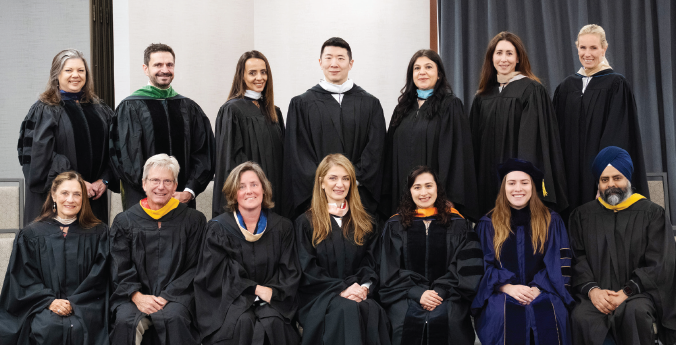
Board members at the 2025 EPS Graduation ceremony. Back row: Amy Pannoni, Habib Rahbar, Gagan Oberoi, Cliff Su, Bengu Bostanci, Jill Jackson, Lisa Simonyi. Front row: Maureen O’Hara, Henry Sanders, Meg Crow, Mehrane Mokdad, Alicia Moreno Gonzalez, Marta Picoto, Amit Bhutani.
PUTTING PRACTICE INTO ACTION
While it is easy to put words on a page to explain a partnership, it really does not become tangible for a reader without a practical example. For spring EBC season, the oversight, planning, and execution of this incredible week outside of the EPS physical walls is a good example of how trustees and school leaders partner to ensure a safe, educational experience. It requires extraordinary planning and execution to get 500+ students and accompanying chaperones to destinations all over the globe in one week. The Director of Student Well-Being and the EBC leadership team are responsible for the creation and selection of trips and experiences and the planning and logistics necessary to ensure a smooth execution. While the Board is not responsible for EBC trip design or selection, we have risk governance oversight and can be a thought partner within the parameters of that lane. In alignment with the principle of clear communication, the Health and Safety committee and full Board receive appropriate updates throughout the year, from the earliest stages of location selection to the planning and execution stages. We review the safety of proposed international locations, track records of partner companies and operators, and ask questions about certain activities to ensure that all aspects of risk management are considered. Our lanes are clear—we offer insight and perspective on topics of risk management and financial oversight, while trusting in school leadership to manage the details of the educational experience. And in the spirit of healthy boundaries, we are careful to only wear our “board hats” and leave in the TALI boardroom the much anticipated details of which trips are being offered (as much as our EPS children may wish otherwise!). When we all approach the exercise with clarity on our roles, the process is efficient and collaborative and the collective end product is even better.
The partnership between trustees and school leadership is one of the most consequential relationships in an independent school. It is a blend of governance and leadership, strategy and execution, vision and stewardship. When nurtured with trust, communication, and clear boundaries, it becomes a powerful force for institutional health. Families may never see the weekly hallway conversations, late-night phone calls, inner workings of monthly board meetings, or the careful preparation behind major decisions. But we hope you feel results—in the school’s culture, its stability, and its ability to stay true to its mission while evolving for the future.